This is the 100th blog post, and the counter of page views is about to tick over 50,000. Thank you for your readership!
According to Google's infallible stats counters, here's what most people have been reading on this blog:
POEMS At the end of a day of being a computer nerd, you need something that will make you laugh (or at least smile) and also make you look cultured among your friends. Nobody else writes poetry about nuclear physics or time travel, so if you want to get that "I'm so hip" feel, you really should buy a copy of When Medusa went on Chatroulette for $3 (more or less, depending on your country of origin).
NAVIGATOR - If you run Data Protector then you will definitely get some value out of the cloud-hosted Navigator trial. You can get reports like "what virtual machines are not getting backed up?" and "how big will my backups be next year?" -- stuff that makes you look like the storage genius guru (which you probably are anyway, but this just makes it easier to prove it).
HOW LONG WILL IT TAKE - If you are tracking your work in Atlassian's fabulous JIRA task tracking system, then try out my free plug-in (x.ifost.org.au/aeed) which can predict how long tasks will take to complete. And if you are not using JIRA, then convince everyone to throw out whatever you are using and switch to JIRA because it's an order of magnitude cheaper, and also easier to support.
TRAINING COURSES - You can now buy training online from store.data-protector.net -- and it appears that it's 10-20% cheaper than buying from HPE directly in most countries. There are options for instructor-led, self-paced, over-the-internet and e-learning modules.
SUPPORT CONTRACTS - Just email your support contract before its renewal to gregb@ifost.org.au and I'll look at it and figure out a way to make it cheaper for you.
BOOKS - If you are just learning Data Protector, then buy one of my books on Data Protector (available in Kindle, PDF and hardback). They are all under $10; you can hide them in an expense report and no-one will ever know.
Showing posts with label cloud. Show all posts
Showing posts with label cloud. Show all posts
Thursday, 10 December 2015

Wednesday, 25 November 2015
VMware ESX 6.0 bug with CBT

VMware has announced another CBT problem. Just a reminder, this is not a problem that HPE can do anything about in Data Protector -- it's a problem with the APIs that VMware have supplied for HPE to use.
If you are doing VEAgent backups of your VMware environment (which is quite common) and you have any incrementals scheduled (also quite common), and you are running ESX 6 (which is lots of people) and you are using CBT (which you really, really would want to do normally).... then you might want to be aware that (yet again) VMware have announced that your backups could well be painfully broken.
Here's VMware's KB article:
http://kb.vmware.com/selfservice/microsites/search.do?language=en_US&cmd=displayKC&externalId=2136854
There are several solutions:
Only do full backups. Hmm, that's a lot of data. Probably OK if you are going to a StoreOnce dedupe, but that's going to turn into a lot more tape.Turn off CBT. Ouch, that's going to hurt performance.Downgrade to ESX 5.5. I don't see anyone doing that.Using the DataProtector disk agent and automated disaster recovery module. This is actually cheaper (no extension licenses required!) and gets you both a file-level backup and an ability to restore a virtual machine from nothing. I recommend this as a better approach generally, but particularly now when we can't trust our VM-level backups.- Apply the patch that VMware has now released.
Less easy solutions, but things to think about:
- Migrate all your virtual machines to Amazon machine images. (Or Google, or Azure. Pity it can't be HP any more). It's inevitable -- eventually -- that the economies of scale of the large cloud providers will overtake your ability to run things in your own data centre. So why not start planning for it now?
- Use a different virtualisation solution. This is not the first time that VMware have announced "by the way, all backups are broken". I suspect it won't be the last time either. KVM is very mature now and it's also free. Xen is in good shape too. Virtualisation technology is no longer cutting edge -- it's commoditised now. So why not pay commodity prices?
Greg Baker is an independent consultant who happens to do a lot of work on HP DataProtector. He is the author of the only published books on HP Data Protector (http://www.ifost.org.au/books/#dp). He works with HP and HP partner companies to solve the hardest big-data problems (especially around backup). See more at IFOST's DataProtector pages at http://www.ifost.org.au/dataprotector, or visit the online store for Data Protector products, licenses and renewals athttp://store.data-protector.net/
Thursday, 5 November 2015
Pre-mortem for almost every cloud-hosted backup provider
I was talking to a vendor who wanted me to partner with them on their cloud-hosted backup solution. I looked at their pricing, and their offerings (managed storage in the cloud, DR servers in the cloud) and then compared what they could do with Amazon. Since only Google and Microsoft can compete with Amazon's scale (and then, only just), the vendor's offerings were way out of line with market rates now.
I suggested that they had three options:
I suggested that they had three options:
- They could make their product work nicely with Amazon cloud (i.e. backup to S3, manage the migration to and from Glacier). A variation would be to do this with Google Nearline Storage, which is probably a better solution, even if it doesn't have the same name recognition. They will lose a lot of revenue because there used to be margin in online storage -- but there isn't any more.
- They could migrate their entire customer base to an open source option (Bacula or BareOS). Since their customer base is going to be cannibalised anyway, they might as well make some money from the consulting effort migrating the customer somewhere else. Open source backup can still compete against cloud offerings in a couple of different ways.
- They could become roadkill.
Fortunately, they do have other sources of revenue, so hopefully they will be able to carry on. But for other specialist cloud-backup companies? I'm not sure that they many of them have a viable future.
Greg Baker is an independent consultant who happens to do a lot of work on HP DataProtector. He is the author of the only published books on HP Data Protector (http://www.ifost.org.au/books/#dp). He works with HP and HP partner companies to solve the hardest big-data problems (especially around backup). See more at IFOST's DataProtector pages at http://www.ifost.org.au/dataprotector
Thursday, 22 October 2015
HP gives up against Amazon
So the HP public cloud is no more. I suspect I might have been one of the larger users of it (for a few weeks back in 2012) so let me try to give a serious analysis of what this means. (HP announcement link)
Amazon AWS is currently supply-constrained. They could lower prices to gain more customers, but then they wouldn't be able to service those customers. This is an unusual position to be in, as almost all of us are in industries where the bottleneck to growth is in acquisition, not delivery. So they ease their prices down little-bit-by-little-bit as they resolve their supply constraints.
Eventually, AWS will start to be demand-constrained, and that's when all hell breaks loose, because then AWS can start doing some serious price cutting. I'd peg it for early 2017 at a guess, when suddenly the price cuts start accelerating until the economics for renting from AWS starts to look competitive with buying a server and putting it on a desk unsupported, un-networked and unpowered.
Google and Azure can survive Amazongeddon -- they have the money and it's a market that they definitely want to be in. Google App Engine is still a very cost-effective offering -- my total compute and storage budget leading up to launch day (and including it) for the Automated Estimator of Effort and Duration for Jira was $0.22 -- so much for big data analysis being expensive! At that level, price comparisons are utterly meaningless, so if that's profitable now (which is probably is), they can keep doing it.
HP have presumably decided that they don't have enough time to build out a solid customer base on the HP public cloud before Amazongeddon. The HP cloud team is betting that customers will want HP software to manage their clouds, and that an HP-backed public cloud is not worth doing. Operations Orchestration makes sense in a cloudy world, for example.
But there is a problem, because for all the talk of "hybrid public-private clouds", either private is cheaper/better/more secure or public is cheaper/better/more secure.
Unfortunately, I believe the answer is "public", as do many, many other people. To say that "private" clouds are cheaper / better and more secure the majority of the time means that not only are there no economies of scale in a big data centre, that there are diseconomies of scale that are going to appear any moment now from out of nowhere.
This puts HP in the same position as Unisys was in the 1980s-1990s. Customers stopped buying Unisys mainframes, so Unisys had to turn into a services, software and support business. They had a bit of an edge in government and defence at the time, and they worked hard to keep it. I know plenty of people who have had good careers at Unisys, and presumably it's a nice place to work where there is innovation happening. But Unisys in 2015 is not the hallowed place that it was after the Burroughs / Sperry merger.
Without that core of hardware sales on which to stack software sales, Unisys struggled. So too will HP. (And so will Dell, unless Dell decides to take on Amazon... which they could and should.)
I feel sorry for Bill Hilf though, as he has had to lead teams through the collapse of high-end Itanium hardware and now through the failure of the only viable hardware future that HP had.
That said, I'm optimistic about HP Data Protector in particular. There will still be important data to backup and archive. Storing it efficiently for fast recovery will always matter. You can't discard a backup solution until the last of your 7-year-old backups have expired.
I'm hoping that HP will now do three things:
Greg Baker is an independent consultant who happens to do a lot of work on HP DataProtector. He is the author of the only published books on HP Data Protector (http://www.ifost.org.au/books/#dp). He works with HP and HP partner companies to solve the hardest big-data problems (especially around backup). See more at IFOST's DataProtector pages at http://www.ifost.org.au/dataprotector
Amazon AWS is currently supply-constrained. They could lower prices to gain more customers, but then they wouldn't be able to service those customers. This is an unusual position to be in, as almost all of us are in industries where the bottleneck to growth is in acquisition, not delivery. So they ease their prices down little-bit-by-little-bit as they resolve their supply constraints.
Eventually, AWS will start to be demand-constrained, and that's when all hell breaks loose, because then AWS can start doing some serious price cutting. I'd peg it for early 2017 at a guess, when suddenly the price cuts start accelerating until the economics for renting from AWS starts to look competitive with buying a server and putting it on a desk unsupported, un-networked and unpowered.
Google and Azure can survive Amazongeddon -- they have the money and it's a market that they definitely want to be in. Google App Engine is still a very cost-effective offering -- my total compute and storage budget leading up to launch day (and including it) for the Automated Estimator of Effort and Duration for Jira was $0.22 -- so much for big data analysis being expensive! At that level, price comparisons are utterly meaningless, so if that's profitable now (which is probably is), they can keep doing it.
HP have presumably decided that they don't have enough time to build out a solid customer base on the HP public cloud before Amazongeddon. The HP cloud team is betting that customers will want HP software to manage their clouds, and that an HP-backed public cloud is not worth doing. Operations Orchestration makes sense in a cloudy world, for example.
But there is a problem, because for all the talk of "hybrid public-private clouds", either private is cheaper/better/more secure or public is cheaper/better/more secure.
- If the answer is "private", then we will continue to have internal customer-owned datacentres, and HPE will continue to sell 3PARs, SureStores, Proliants and so on.
- If the answer is "public", then after Amazongeddon, HP won't have a hardware business that anyone cares about.
Unfortunately, I believe the answer is "public", as do many, many other people. To say that "private" clouds are cheaper / better and more secure the majority of the time means that not only are there no economies of scale in a big data centre, that there are diseconomies of scale that are going to appear any moment now from out of nowhere.
This puts HP in the same position as Unisys was in the 1980s-1990s. Customers stopped buying Unisys mainframes, so Unisys had to turn into a services, software and support business. They had a bit of an edge in government and defence at the time, and they worked hard to keep it. I know plenty of people who have had good careers at Unisys, and presumably it's a nice place to work where there is innovation happening. But Unisys in 2015 is not the hallowed place that it was after the Burroughs / Sperry merger.
Without that core of hardware sales on which to stack software sales, Unisys struggled. So too will HP. (And so will Dell, unless Dell decides to take on Amazon... which they could and should.)
I feel sorry for Bill Hilf though, as he has had to lead teams through the collapse of high-end Itanium hardware and now through the failure of the only viable hardware future that HP had.
That said, I'm optimistic about HP Data Protector in particular. There will still be important data to backup and archive. Storing it efficiently for fast recovery will always matter. You can't discard a backup solution until the last of your 7-year-old backups have expired.
I'm hoping that HP will now do three things:
- Convert the HP cloud object storage device to something that works with S3. Since this feature will be irrelevant in January 2016 if they don't do this, it seems like a no-brainer in order to preserve the R&D investment done so far.
- Interface into lifecycle management of S3 -- if the "location" of a piece of media is "Glacier", then Data Protector should be able to initiate its re-activation as step 1 of a restore job. Again, this seems a no-brainer if you already are dealing with S3.
- I'd like to see the Virtual Storage Appliance delivered as an AMI (Amazon machine image). This isn't very difficult. Maybe there could be some fiddling around with licensing where the VSA reported its usage and customers paid by capacity per month, but even that's not really necessary.
If all this happens, then I suspect we'll continue to see HP selling Data Protector for another 30 years. If Data Protector is still useful for customers post-Amazongeddon as it is pre-Amazongeddon, then there would be no particular reason that Data Protector couldn't pass through this critical tipping point. In fact, since I doubt that BackupExec will handle the transition, Data Protector will probably pick up some market share.
Anyway, what are some immediate scenarios would this support?
Anyway, what are some immediate scenarios would this support?
- Customer A has a small Amazon presence and a large data centre with a StoreOnce system and some tape drives. They would like to deploy a VSA in the same region as their Amazon servers and replicate their data through low-bandwidth links back to their data centre.
- Customer B has a somewhat larger Amazon presence. They have Data Protector in their office, and they want to backup their Amazon content to Glacier.
- Customer C is closing down their data centre in house and moving their servers into the cloud. They want to take backups of their servers in their data centre and use StoreOnce replication to get them into their cloud where the data is rehydrated.
So if you are customer like A, B or C, feel free to contact to your account manager, suggest that you'd really like Data Protector to support you and see how you go. (Or get in touch with me and I'll collate some answers back to the product team.)
Greg Baker is an independent consultant who happens to do a lot of work on HP DataProtector. He is the author of the only published books on HP Data Protector (http://www.ifost.org.au/books/#dp). He works with HP and HP partner companies to solve the hardest big-data problems (especially around backup). See more at IFOST's DataProtector pages at http://www.ifost.org.au/dataprotector
Tuesday, 24 February 2015
Planning, Deploying and Installing Data Protector 9: For the datacentre, the cloud and remote offices
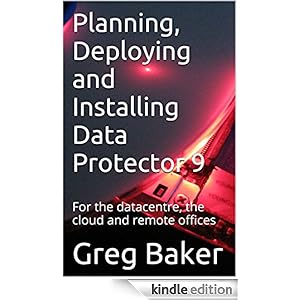
This is the fourth book I've published on HP Data Protector, and I think it will be a very valuable resource to any sysadmin or consultant working with HP products.
If you are involved in pre-sales or implementation consulting you will find lots of useful material in this book.
- Why customers choose Data Protector, and what its strengths and weaknesses are.
- Step-by-step, everything you would need in order to backup remote branch offices.
- Very detailed designs on how you can backup Amazon-hosted cloud servers.
- How to backup data centres filled with nearly identical virtual machines.
- Guidance on handling media pools, tape drives and other physical devices.
- Doing disk-to-disk-to-tape backups.
- Very detailed information on the internal database that simply isn't available elsewhere -- the results of my reverse engineering what HP has done. If you have complicated reporting needs, this is the book to have.
This book can also be used as a course book if you want to run a one-day training session. All the labs can be run up in the cloud.
To keep the price down on the paperback version, it's a B&W print for all 374 pages. The Kindle version is full-colour if you have a full-colour device.
The paperback version has a comprehensive index to make this into an ideal reference to have at your desk. It is enrolled in matchbook, so you can have both the paper version and the kindle version for only slightly more than the paper version. Buy both!
Topics covered:
- Reasons customers choose Data Protector
- Areas of comparative weakness
- Installing Windows and Linux cell managers
- Agent deployment methods
- StoreOnce de-duplication
- Backing up filesystems
- Backing up VMware
- Backing up cloud-hosted servers
- Configuring tape drives
- Managing media
- Backups spooled via disk
- Remote office backups replicated to a central office
- Reporting
There is also a companion book on Data Protector for operators with a topics around restoring, supporting and maintaining.
Buy it on Amazon ( http://www.amazon.com/dp/B00T68FR64 ), or if you want to use an alternate store, they are listed here: http://www.ifost.org.au/books
Greg Baker is one of the world's leading experts on HP Data Protector. His consulting services are at http://www.ifost.org.au/dataprotector. He has written numerous books (see http://www.ifost.org.au/books) on it, and on other topics. His other interests are startup management, applications of automated image and text analysis and niche software development.
Wednesday, 4 February 2015
Moment-in-time (snapshot) backup of Amazon AWS / EC2 instances
This post is the second in my series on backing up servers in the cloud. (The previous post was here: http://blog.ifost.org.au/2015/01/using-data-protector-to-back-up-your.html.) Obviously, there are some servers in the cloud that you simply won't need to backup, but the remainder which you do need to backup are much harder.
The big problem (which I will address in the next post in this series) is the cost of long-term storage. If you want to maintain backups for seven years, even Amazon Glacier will be absurdly expensive.
The other problem is the challenge of getting a consistent moment in time backup. Only the very minor cloud infrastructure service providers are offering VMware or Hyper V as their main offering, so virtual disk snapshot backups aren't an option.
On Windows systems there is VSS, so a file system backup taken with a VSS snapshot option will be a reasonably consistent moment in time.
However, most servers run Linux. Many of them are running a database of some sort (PostgreSQL or MySQL). It is possible to arrange a pre-exec to dump the database to disk, but this gets increasingly impractical as the database gets larger.
I wrote a blog article about one method (LVM) to get consistent Linux backups last year (http://blog.ifost.org.au/2014/07/moment-in-time-snapshot-backups-of.html ). But with Amazon it is possible to use the snapshot capability they provide.
The scripts on this page assume that your instance has one EBS volume that it boots from, and no other attached storage.
Create a backup job that will backup /mnt (even though the server doesn't have a mounted filesystem there). If necessary, just edit the data list:
If the Amazon EC2 tools are not already installed and configured in the environment, you will need to install them. Most of the Amazon-supplied AMIs have these already in-place, but the Redhat-supplied ones don't.
Then we flush as much out to disk as we can (with the sync commands, and then freeze I/O on the root filesystem). Any thing that tries to write to disk will block until after the snapshot is completed. Read operations will still work. We run a busier loop checking to see if the snapshot is ready.
After that, we turn the snapshot into a volume, and attach that volume to a device which will probably be free. There will be an error in dmesg about the lack of a partition table on /dev/xvdf but it doesn't seem to matter.
Finally we mount /mnt (ready to be backed up) and remember what volumes we just created.
I hope you find this helpful.
Greg Baker is one of the world's leading experts on HP Data Protector. His consulting services are at http://www.ifost.org.au/dataprotector . He has written numerous books (see http://www.ifost.org.au/press ) on it, and on other topics. His other interests are startup management, applications of automated image and text analysis and niche software development.
The big problem (which I will address in the next post in this series) is the cost of long-term storage. If you want to maintain backups for seven years, even Amazon Glacier will be absurdly expensive.
On Windows systems there is VSS, so a file system backup taken with a VSS snapshot option will be a reasonably consistent moment in time.
However, most servers run Linux. Many of them are running a database of some sort (PostgreSQL or MySQL). It is possible to arrange a pre-exec to dump the database to disk, but this gets increasingly impractical as the database gets larger.
I wrote a blog article about one method (LVM) to get consistent Linux backups last year (http://blog.ifost.org.au/2014/07/moment-in-time-snapshot-backups-of.html ). But with Amazon it is possible to use the snapshot capability they provide.
The scripts on this page assume that your instance has one EBS volume that it boots from, and no other attached storage.
Create a backup job that will backup /mnt (even though the server doesn't have a mounted filesystem there). If necessary, just edit the data list:
FILESYSTEM "/mnt" cloud-server1.data-protector.net:"/"
{
}
Then put the following two scripts (snapshot-preexec.sh and snapshot-postexec.sh) into /opt/omni/lbin on the cloud hosted server, and modify the backup job to use these as the pre- and post-exec jobs for the backup.If the Amazon EC2 tools are not already installed and configured in the environment, you will need to install them. Most of the Amazon-supplied AMIs have these already in-place, but the Redhat-supplied ones don't.
snapshot-preexec.sh
#!/bin/sh

# First, get our instance ID from Amazon
INSTANCE=$(wget -q -O - \
   http://169.254.169.254/latest/dynamic/instance-identity/document \
    | grep instanceId | cut -d'"' -f4)

# Next, find out zone we are in, for the volume creation later
ZONE=$(wget -q -O - \
   http://169.254.169.254/latest/dynamic/instance-identity/document \
    | grep availabilityZone | cut -d'"' -f4)

# This script only works for single volumes at the moment
VOLUME=$(ec2-describe-instances $INSTANCE \
   | grep BLOCKDEVICE | awk '{print $3}' | head -1)

# Flush everything we can out to disk before we take the snapshot
sync
sync
fsfreeze -f /

# Create a snapshot of our root volume
SNAPSHOT=$(ec2-create-snapshot $VOLUME | awk '{print $2}')
until ec2-describe-snapshots $SNAPSHOT | grep -q completed
do
    sleep 1
done

fsfreeze -u /

# Turn that snapshot into a volume
NEWVOL=$(ec2-create-volume --snapshot $SNAPSHOT -z $ZONE| awk '{print $2}')
until ec2-describe-volumes $NEWVOL | grep -q available
do
    sleep 5
done

# Connect that volume
ec2-attach-volume $NEWVOL -i $INSTANCE -d sdf
until ec2-describe-volumes $NEWVOL | grep -q attached
do
    sleep 5
done

# Mount it
mount /dev/xvdf /mnt

# Now we can back up. Remember what we had though
echo $SNAPSHOT > .snapshot-to-remove
echo $NEWVOL > .volume-to-remove
The first couple of lines will only work on the Amazon cloud. The EC2 instance queries a special Amazon address to find out its own details -- its instance id (e.g. i-121255) and its zone (e.g. us-west-2c).Then we flush as much out to disk as we can (with the sync commands, and then freeze I/O on the root filesystem). Any thing that tries to write to disk will block until after the snapshot is completed. Read operations will still work. We run a busier loop checking to see if the snapshot is ready.
After that, we turn the snapshot into a volume, and attach that volume to a device which will probably be free. There will be an error in dmesg about the lack of a partition table on /dev/xvdf but it doesn't seem to matter.
Finally we mount /mnt (ready to be backed up) and remember what volumes we just created.
snapshot-postexec.sh
#!/bin/sh

SNAPSHOT=$(cat .snapshot-to-remove)
NEWVOL=$(cat .volume-to-remove)

umount /mnt

# Detach the volume and wait until it is gone
ec2-detach-volume  $NEWVOL
while ec2-describe-instances $NEWVOL | grep -q ATTACHMENT
do
    sleep 5
done

ec2-delete-volume $NEWVOL
ec2-delete-snapshot  $SNAPSHOT
After the backup, the post-exec removes the mount, the volume and the snapshot.I hope you find this helpful.
Greg Baker is one of the world's leading experts on HP Data Protector. His consulting services are at http://www.ifost.org.au/dataprotector . He has written numerous books (see http://www.ifost.org.au/press ) on it, and on other topics. His other interests are startup management, applications of automated image and text analysis and niche software development.
Thursday, 29 January 2015
Using Data Protector to back up your AWS (Amazon EC2) instances
Your cloud-hosted infrastructure (whether it is on Azure, AWS, Google App Engine, IBM Rackspace or HP Cloud) is going to consist of:
- Cattle, which are machines that you have automatically created and which contain no state that can be lost. They might have a replica of some data, but there will be other copies. If these machines fail, you just restart them or create a new instance. Hopefully you have this process automated.
- Pets, which are machines that you administer and are installed manually. When these fail, you want to restore from a backup.
If you are a completely green-field site, then you won't have any backup infrastructure. But if you already have some in-house servers, then you will probably have existing backup infrastructure that you would want to make use of.
For example, the cheapest storage in the cloud at the moment appears to be Amazon Glacier, which costs USD10 per terabyte. But if you already have a tape library (or even a single standalone modern tape drive), you can easily have long-term cold storage at $0.50 per TB or less, and you probably already have some tapes.
Likewise, if you already have a Data Protector cell manager license, you might as well keep using it because it will work out cheaper than any dedicated cloud-hosting provider.
Virtual tape library
This option is appropriate if you are very, very constrained by your budget and need to be very conservative in how you do backup changes. If you are currently backing up to a tape library, then this lets you keep the illusion of the same thing but put it into the cloud.
- Create a Linux instance in an availability zone that you are not otherwise using.
- Install mhvtl on to it, and configure a virtual tape library with it.
- Mount a very large block image (persistent storage device) on /opt/mhvtl.
- You can now use this tape library just as if it were a real tape library.
AWS (Elastic Block Store) volumes
The problem with the virtual tape library solution is that you are somewhat constrained by the size of the block storage that you are using. But with an external control device, you can attach and detach Elastic Block Store (EBS) volumes on demand as required. You can add slots to the external device by adding additional block stores.
- Create a Linux instance in an availability zone that you are not otherwise using.
- Write an external control script which takes the DP command arguments and attaches and detaches EBS volumes to the Linux box.
- Create an External device, using that script.
StoreOnce low-bandwidth replication
The previous two options don't offer a way of using in-house tape drives.
If you have a way of breaking up your backups into chunks of less than 20TB, then you can use the software StoreOnce component on an EC2 instance. It works on Windows and Linux; just make sure that you have installed a 64-bit image. The only licensing you will need is some extra Advanced Backup to Disk capacity.
An alternative is to buy a virtual storage appliance (VSA) from HP, and then creating an Amazon Machine Image (AMI) out of it. This has the advantage that it can cope with larger volumes, and it also has better bandwidth management (e.g. shaping during the day, and full speed at night).
The steps here are:
- Run up a machine in an availability zone which is different to whatever it is you are wanting to back it up. Use a Windows, Linux or VSA image as appropriate. Call it InCloudStorage-server
- Create a StoreOnce device (e.g. "InCloudStorage").
- Create backups writing to "InCloudStorage".
- Create a StoreOnce device in-house. Call it "CloudStorageCopy".
- If you are not using a VSA you will need to create a gateway for CloudStorageCopy on InCloudStorage-server. Remember to check the "server-side deduplication button".
- Create a post-backup copy job which replicates the backups (which went to InCloudStorage) to CloudStorageCopy using that server-side deduplicated gateway.
- Create a post-copy copy jobs to copy these out to tape.
The beauty of this scheme is that you can seed the CloudStorageCopy with any relevant data. As most of the virtual machines you are backing up will be very similar, you will achieve very good deduplication ratios. 20:1 is probably reasonable to expect, or possibly higher. So instead of having to transfer 100GB of backup images from the cloud to your office each day, you might only be transfering 5GB, which is quite practical.
HP cloud device
I discussed this in http://blog.ifost.org.au/2015/01/data-protector-cloud-backups-and-end-of.html . If you are using the HP cloud, then this is almost a no-brainer -- you don't even need to provision a server. For the other cloud providers, it depends on the bandwidth you get (and the cost of the bandwidth!) to the HP cloud whether this makes sense or not.
Greg Baker is an independent consultant who happens to do a lot of work on HP DataProtector. He is the author of the only published books on HP Data Protector (http://www.ifost.org.au/press/#dp). He works with HP and HP partner companies to solve the hardest big-data problems (especially around backup). See more at IFOST's DataProtector pages at http://www.ifost.org.au/dataprotector
Saturday, 24 January 2015
@16z Outside of the USA, are we also seeing the same 16 themes in the way software eats the world? Here are my Oz impressions
I was perusing Marc Andresson's website. Marc is one of the better known venture capitalists and famously wrote that software is eating the world.
On his website there are 16 themes that he is seeing. Obviously, he invests big money in big startups, where I tend to be advising smaller and less splashy groups with little or no up-front cash. And north-western Sydney isn't Palo Alto. But there is quite a lot in common:
On his website there are 16 themes that he is seeing. Obviously, he invests big money in big startups, where I tend to be advising smaller and less splashy groups with little or no up-front cash. And north-western Sydney isn't Palo Alto. But there is quite a lot in common:
- Sensorification of the enterprise. Yes, the insurer-broking-customer system I've been developing with the best and brightest in the industry is doing that, and that's one of the big takeaways. We haven't even begun to tap what can be done with mobile sensors. This one is universal.
- Machine learning and big data. Obviously, I spend a lot of time helping customers with big data storage (as that's the other three-quarters of my work). Backup and recovery of big data is an issue that no-one knows how to do properly (myself included). But on the machine learning side, yes, I'm seeing this everywhere. There was the project where I was extracting keywords out from emails ( http://blog.ifost.org.au/2014/05/keywords-from-emails-on-google-app.html ) and displaying a colour summary of what the author of the email thinks about those topics. The data we got from the big data analysis I did of COI group's staff attitudinal surveys was extraordinary -- did you know that there are 5 distinct different ways to be a successful organisation, and another 14 to be unsuccessful? In another we found that a flower shop should stay open an hour later.
- Containerisation is not a trend I'm seeing yet in customers with existing infrastructure. What I am seeing is customers simply not having their own data centre presence -- not even maintaining a server rack or a local server. So the containerisation I'm seeing is more around self-contained applications managed by different companies.
- Digital health. From the dental camera system that I've been developing, to the start-up I was talking to last week, software is eating up the entire medical device industry. The medtech industry (which is big in Sydney -- bigger than most people realise) is turning into a developer of sophisticated software for small cheap sensors.
- I'm not seeing the efficient online marketplaces trend as clearly. Perhaps because I'm based in Australia with a smaller less efficient market (in general) but specialty and uniqueness is still common, and I don't see any Australian companies racing to the bottom on price and staying in business.
- Bitcoin and blockchain. The retailers I'm speaking to don't see bitcoin as a priority, but they don't really have a problem with it. So it will come, and the volatility will reduce. On the other hand, if I put insurance contract binding information into the blockchain, I'm pretty sure my insurance customers would freak out and run hiding. So this trend will come from the retail side.
- Funnily enough, whether to do cloud-client computing is a pressing question that I'm researching at the moment. That is, for two projects I'm doing at the moment I know I have a lot of in-mobile image and sound analysis computation to do. Bandwidth from the mobile is a problem, but so is CPU time on the mobile. Where to do it? It's not obvious which is better.
- I'm not doing any work for Controlability any more (that stopped when I went to google), but we were well ahead of the curve on that. What we were building in Darwin and Brisbane (hardly centres of technology) are what a whole bunch of "Internet of things" startups are trying to do now. It was secure, it was sensible, it was cost-effective and it made the residential development companies money. So I'm a bit biased on this: I think the rest of the world is playing catch-up.
- I can't say much about online video, but it seems to me that the money previously being spent on face-to-face training and e-learning is there for the taking as these move to video. I still don't have any video content to sell for anything I'm doing (I'm still writing books) but I can see the market is ready for it. Australia was well ahead of this curve, as the business of doing face-to-face training went undead several years ago; from what I've seen India and China are well behind on this curve.
- The changes sweeping the insurance industry: yes: real-time data extraction from company systems to give a day-by-day risk premium. We're working on it.
- DevOps: the week before last I was talking to a very famous software company about their SaaS offering. They have a long, long way to go to get from "sysadmins of a box that runs an application" to "site reliability engineering". Maybe, just maybe, some of the other Australian SaaS players are doing it better, but I doubt it. So few companies here have enough scale that they can do any statistically meaningful analysis of their outages or incidents. So while lots of people will talk about it, it's going to be a long time before DevOps is going to make a measurable difference here, sadly.
- Failure and the culture of fail fast. I see no evidence of this anywhere here. The vast majority of start-ups are self-funded, boot-strapping and grabbed an opportunity that arose. The QUT CAUSEE study showed no correlation between the success of a start-up and the number of failed startups the principals had been involved in. The closest QUT found was a kind of bonus for pivoting: if you changed direction as a result of customer feedback directing the company to a new product or solution in that industry then that was a very good predictor of success.
- I don't have enough experience to comment on full-stack startup, virtual reality and crowdfunding
- While I used to be able to say with confidence that I was a security guru, I don't think I can comment on Andresson's theme; I'm probably losing it.
What I found interesting is what didn't appear, but are really clear themes that I'm seeing:
- Image analysis is everywhere. Every company has dozens of problems which can be solved by moderately simple image analysis techniques. There simply aren't enough knowledgeable gurus out there to do the work.
- Interfacing with the low-tech. I think there's a Silicon Valley bubble which assumes that everyone wants to be on-line with a smart-phone all the time. But there are many workers and customers that simply can't or won't do this. In the last few weeks: a startup the severely disabled on-line with assistive technology; the retail conversations were around simplifying warehousing procedures so that the tech un-savvy can cope; the edutech project getting tech-averse sport coaches to be able to put wet weather into their school's twitter, facebook and skoolbag systems.
Thursday, 22 January 2015
Data Protector cloud backups and the end of tape
The end of tape storage is not quite here yet. There are times when you really, really want to keep data off-line so that it is definitely safe from sysadmin accidents and sophisticated hackers.
But there is a lot of data that doesn't quite meet those needs. I've used rsync.net, and LiveVault and while they are useful too, what the world really needs is one backup solution that can do local disk, local tape and also replicate to the cloud very, very fast and very, very cheaply.
HP appears to have done this with Data Protector 9.02. There's a nice new option under "backup to disk" which appears to be a StoreOnce device running in the cloud.

I was already using HP's public cloud anyway for when I run Data Protector training classes, so it was just a matter of filling in my access keys and so on in the following screens.
The result is a device that can be used for backup, copying, restore, etc. You can back up locally, and have an automatic copy job to replicate it to the cloud. Or you can backup your cloud-hosted servers direct to the cloud, and then drag it back down to copy off to your tape drives later.
At 9c/GB per month it's nowhere near the cheapest on the market (Google was 2c/GB per month last time I checked, and Amazon have their tape-like Glacier service at 1c/GB per month). But that's the cost of the space that you use: deduplication should take care of a lot of this.
What would be nice next: some way of replicating this to a tape library hosted by HP in their public cloud (similar to Amazon).
Greg Baker is an independent consultant who happens to do a lot of work on HP DataProtector. He is the author of the only published books on HP Data Protector (http://www.ifost.org.au/press/#dp). He works with HP and HP partner companies to solve the hardest big-data problems (especially around backup). See more at IFOST's DataProtector pages at http://www.ifost.org.au/dataprotector
But there is a lot of data that doesn't quite meet those needs. I've used rsync.net, and LiveVault and while they are useful too, what the world really needs is one backup solution that can do local disk, local tape and also replicate to the cloud very, very fast and very, very cheaply.
HP appears to have done this with Data Protector 9.02. There's a nice new option under "backup to disk" which appears to be a StoreOnce device running in the cloud.
I was already using HP's public cloud anyway for when I run Data Protector training classes, so it was just a matter of filling in my access keys and so on in the following screens.
The result is a device that can be used for backup, copying, restore, etc. You can back up locally, and have an automatic copy job to replicate it to the cloud. Or you can backup your cloud-hosted servers direct to the cloud, and then drag it back down to copy off to your tape drives later.
At 9c/GB per month it's nowhere near the cheapest on the market (Google was 2c/GB per month last time I checked, and Amazon have their tape-like Glacier service at 1c/GB per month). But that's the cost of the space that you use: deduplication should take care of a lot of this.
What would be nice next: some way of replicating this to a tape library hosted by HP in their public cloud (similar to Amazon).
Greg Baker is an independent consultant who happens to do a lot of work on HP DataProtector. He is the author of the only published books on HP Data Protector (http://www.ifost.org.au/press/#dp). He works with HP and HP partner companies to solve the hardest big-data problems (especially around backup). See more at IFOST's DataProtector pages at http://www.ifost.org.au/dataprotector
Subscribe to:
Posts (Atom)